Minister of Planning, Economic Development, and International Cooperation Reviews the Performance indicators of the Egyptian Economy, Growth Prospects, and the Pillars of Egypt’s Narrative for Comprehensive Development
20 January 2026
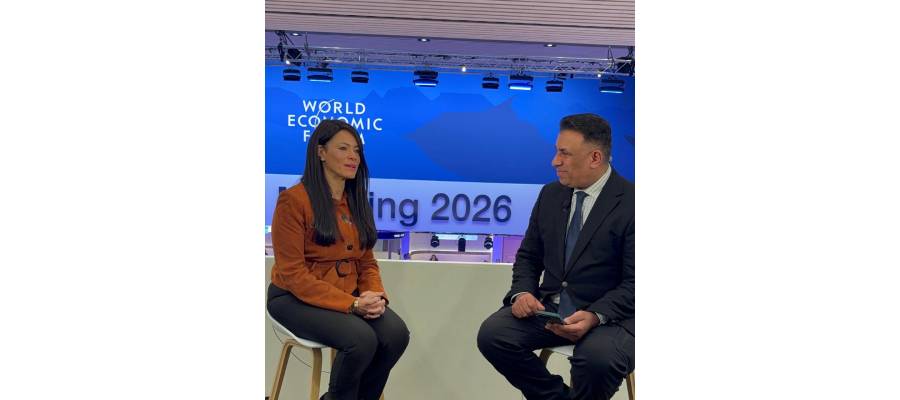
On the sidelines of the World Economic Forum “Davos”
Minister of Planning, Economic Development, and International Cooperation Reviews the Performance indicators of the Egyptian Economy, Growth Prospects, and the Pillars of Egypt’s Narrative for Comprehensive Development
H.E. Dr. Rania
Al-Mashat:
Achieving a growth rate of 5.3% in the first quarter of FY 2025/2026 reflects a recovery of the real economy.
We expect an increase in the positive contribution of the Suez Canal to GDP indicators in the second quarter of the current fiscal year.
Egypt’s Narrative for Comprehensive Development is not limited to economic and fiscal policies, but extends to the social dimension, with the citizen at the center of attention.
Governance of public investments to create more investment opportunities for the private sector.
We aim to increase the private sector’s share of total investments to over 70% by 2030.
The industrial sector is witnessing a strong comeback, reflecting growing confidence in the Egyptian economy and increasing investment opportunities.
For the first time, we announce a list of policies and measures within the National Structural Reforms Program with specific timelines.
H.E. Dr. Rania
Al-Mashat, Minister of Planning, Economic Development, and International
Cooperation, emphasized that Egypt’s participation in the World Economic Forum
in Davos comes within the framework of its commitment to strengthening global
dialogue on international economic issues, trade, and artificial intelligence.
She noted that this participation takes place alongside government officials,
decision-makers, and heads of global companies.
This came during
the Minister’s interview with CNBC Arabia. H.E. Dr. Al-Mashat highlighted the
most prominent economic developments in Egypt, the performance of growth
indicators during the current fiscal year, as well as the features and
objectives of Egypt’s Narrative for Comprehensive Development.
H.E. Dr. Al-Mashat
pointed out that Egypt concluded FY 2024/2025 with a growth rate of 4.4%, while
the first quarter of FY 2025/2026 recorded a growth rate of 5.3%, exceeding
expectations. This was driven by growth in the industrial sector and the strong
performance of the tourism, communications, and information technology sectors.
H.E. Dr. Al-Mashat
reiterated that the tourism sector witnessed a notable increase in tourist
arrivals and revenues, reaching unprecedented levels. She also stressed that
economic growth in Egypt has become diversified and no longer dependent on a
single sector. The real economy is experiencing broad momentum as a result of
ongoing reforms, reflecting the beginning of a genuine recovery in preparation
for a strong economic takeoff.
The return of
navigation in the Suez Canal and its impact on economic growth
Regarding the
impact of the return of navigation to the Suez Canal on growth indicators, the
Minister mentioned that the first quarter of FY 2025/2026 saw a positive
contribution from the Canal after two years of negative contributions. She
noted that major global shipping companies have begun to return, which will
lead to increased positive contributions during the second quarter of the
current fiscal year.
H.E. Dr. Al-Mashat
reaffirmed that the Suez Canal represents a vital artery for global trade, with
around 12% of global trade passing through it. Stability of navigation in the
Canal contributes to reducing the cost of transporting goods and thus curbing
global inflation rates. She added that this represents a positive signal for
Egypt, the region, and the world, as the Canal enhances global supply chains
and facilitates trade flows.
Egypt’s Narrative
for Comprehensive Development as a strategic framework for growth
The Minister also referred
to the second edition of Egypt’s Narrative for Comprehensive Development. She
underscored that Egypt possesses an integrated economic model based on
increasing productivity and expanding exports, following massive investments in
infrastructure over recent years.
H.E. Dr. Al-Mashat
explained that the first edition of the Narrative was launched last September
and was developed through an extensive societal dialogue involving more than
120 experts. This resulted in a clear executive plan that will be presented to
the new House of Representatives.
H.E. Dr. Al-Mashat
added that the second edition includes a full pillar on human development,
considering the citizen as the core of the development process. The Narrative
is not limited to economic and fiscal policies, but extends to social
dimensions such as education, comprehensive health insurance, and social
protection.
The National
Structural Reforms Program
In response to
questions on whether Egypt’s Narrative for Comprehensive Development is a
crisis-management path or a pathway for economic growth, H.E. Dr. Al-Mashat
reaffirmed that the objective is to achieve strong and sustainable economic
growth based on continuous structural reforms over the medium and long term.
The Minister
pointed out that the government has a clear and publicly announced structural
reform plan with performance indicators and implementation timelines. She also
noted the application of program- and performance-based budgeting across all
ministries, ensuring the achievement of specific targets, including per capita
growth and the private sector’s contribution to GDP.
Fostering the role
of the private sector in economic activity
With regard to the
private sector’s contribution, the Minister mentioned that the government is
working to govern public investments in order to allow for an expanded role for
the private sector in economic activity. The private sector currently accounts
for about 65% of total investments, with a target to exceed 70% by 2030.
H.E. Dr. Al-Mashat
added that this approach is based on structural reforms in tradable sectors
such as tourism, agriculture, energy, communications and information
technology, and manufacturing industries. She emphasized that the industrial
sector is currently witnessing a strong resurgence, reflecting growing
confidence in the Egyptian economy, particularly in light of available
investment opportunities and Egypt’s strategic location as a hub for
manufacturing and exporting to Africa and Europe.
The National
Structural Reforms Program
H.E. Dr. Al-Mashat
also spoke about the National Structural Reforms Program, explaining that it is
one of the most important pillars of economic reform in Egypt. The program aims
to achieve three main objectives: macroeconomic stability, improving the
business environment and competitiveness, and supporting the green transition
and new and renewable energy.
She confirmed that
the program is characterized by full transparency, as its details have been
published publicly for the first time. The Minister also clarified the
responsibilities of each ministry and the timeline of implementation progress,
thereby opening the door to local and foreign investments.
Improving the
quality of life for citizens
In concluding her
remarks, H.E. Dr. Rania Al-Mashat reiterated that the primary goal of economic
reforms is to improve the quality of life for Egyptian citizens. She noted that
the reforms are based on an interconnected cycle that begins with macroeconomic
stability, passes through structural reforms that support economic, human, and
industrial development, and culminates in the creation of decent job
opportunities and improved public services. The Minister added that this year’s
World Economic Forum theme is “A Spirit of Dialogue” which fully aligns with
the direction of the Egyptian state.
H.E. Dr. Al-Mashat
further noted that these reforms aim to create adequate fiscal space for both
investment and current spending to improve quality of life, in addition to
enhancing private sector investments to increase employment opportunities and
achieve sustainable development.
-

-

-

-
 copied successfully